Now, Canada, there are better ways to seek retribution
A recent Reuters news segment shows a group of German pensioners appearing in court for kidnapping their financial advisor! Now, remember, folks, if you feel hard done by there are a number of ways to seek retribution. ;)
For financial advisors out there, it's just that time again. "That time." ... A period where everything just makes sense for a people or person. For bears, it's springtime when they come out of hibernation with plenty of food and no hunting allowed. For Brazilians, it's whenever there's a World Cup to be won. For Jay Leno, it's whatever time he successfully usurps the latest successor of The Tonight Show.
For financial advisors, that time of the year where the glory and significance of their profession is felt by the masses is RSP season. A time when personal finance and retirement goals is at the forefront of all baby boomers' minds. We, as Canadians, are an engaged bunch. During the summer, kids are on summer vacation, the sun is shining and the BBQ is waiting to be lit up. In the fall, it's back-to-school shopping, work speeds up and the latest of whatever is on TV. During Christmas, it's Christmas.
And after the holiday season, that 6 weeks between mid January and the first day of March, Canadians are on high alert. Their credit card bill from this past holiday season has come back and wait... your deadline to contribute to your RSPs is fast approaching. Now, the thing about RSPs is that you can contribute to them throughout the year, but for reasons mentioned in the previous paragraph, many wait until the deadline is coming up. During such a time, it's time to think about financial goals. Spending. Saving. Maybe you don't feel that way, but between the half dozen TFSA vs. RSP articles you keep bumping into and the relentless advertising on TV, you know you should.
One such ad features a couple sitting at a Scotiabank office in which the husband for the life of him can't look at his financial statement. We all chuckle (and I say that loosely) as the wife darts the statement in front of her husband's eyes, who keeps looking away. Maybe we're chuckling or maybe we're rolling our eyes, but the theme of the commerical does bring some truth. A good many of us hate seeing how much we've spent. A good many of us hate seeing how little we've saved... And by merely avoiding these uncomfortable emotions, many of us procrastinate dealing with these important issues.
As much as one might dread a meeting where all such things are acknowledged, one could very well come out of such a meeting feeling cleansed. The more you know, the more confident you become. Just talking will bring clarity. The lady ends the commercial by making a legitimate point: The fact that you're here is a great first step.
This will be my only plug for the retail investment industry this season and since I always lament about everybody itching to be pitching... Let this plug carry some legitimacy. Talk to your financial advisor. If you don't have a financial advisor, poke one's brain (or many). They might try and win your business, but if you're not interested, it can easily be repelled. If you're self-directed, talk to a person at your discount brokerage where you can ask questions about your account or a new service...
I guarantee there's something new to be learned and just talking about this stuff could very well bring some added clarity to these issues in your head. Clarity could be incredibly useful after these last couple years.
Standard & Poors announced yesterday it is launching a Shariah compliant version of the S&P/TSX 60, which, while their first in Canada, will be their 52nd Shariah compliant index fund. For Standard and Poors to come out with investment products sensitive to a large demographic of individuals (Muslims) is a wise move and should be applauded. Shariah is the body of Islamic religious law, which is the third most prevalent legal system in the world after common and civil law. The term "Shariah compliant" suggests that the holdings in this index represent holdings that meet the criteria as prescribed by Islamic law. However, I do want to cast some healthy doubt on this idea of Shariah compliant indices.
Standard & Poors has a "Shariah Supervisory Board" composed of Islamic scholars that decide what investments do or do not qualify. This is where the confusion arises. For one, there are five schools of law in Sharia (four in Sunni Islam and one in Shia Islam). How likely is it that the group adequately represents the proportional sentiment of each school of thought? "Shariah law is open to interpretation and religious boards frequently hold different views on key Shariah issues," El Waleed M. Ahmed writes in the Arab Times.
For example, companies, whose business consists of alcohol, gambling or pornography, would not qualify for the index. This is probably a universal sentiment. However, they go further. "Companies which have high levels of debt or high levels of interest earnings are also screened out," Alka Banerjee, S&P Index Services Vice President, tells CTV. As most public companies (if not all) have either debt, income derived from interest earnings or both, who decides what is considered "high?" In this case, a group of Islamic scholars decided that, currently, companies that have debt under 33% of market capitalization qualify for the index.
How did they come by 33%? Why not 40%? Or 20%? Each number would have an effect on the resulting portfolio. The idea of a group of layman (and I'm sure they are incredibly pious individuals yet unqualified in portfolio management) picking companies out of an index based on a subjective criteria that might differ from one school of thought to another...perhaps we could be chucking darts at a dartboard?
Therefore, it feels like active management without the active management! An actively-managed investment by a group of people that are religious scholars not financial professionals.
Of course, what's important to keep in mind here is the intention of Standard and Poors, which is to the best of their ability to create an investment product that Muslims can invest in. Muslims, for their part, actually might forego investing in such products based on the fact that they could be investing in companies not compliant with their beliefs. Taking advantage of this effort does, at least, give them an opportunity to illustrate they are trying.
Click "announced today" or "Alka Banerjee" to read yesterday's news release.
Why it is important to tell if your mutual funds are 'closet indexers' and 3 ways to identify it
Pundits and casual observers will debate the pros and cons of mutual funds. Mutual funds are probably the most mainstream vehicle of active management, at least as far as retail investors are concerned. It is the appropriate strategy for critics of the efficient market theory, which is the idea that prices on assets, such as stocks and bonds, reflect all known information. The idea is to take advantage of mispricing in the market. As the strategy is in the hands of a money manager, volatility can be managed by investing in less-risky, high quality companies rather than in the market as a whole. It can also allow investors to take on additional risk to exceed higher-than-market returns. Furthermore, investments that are not highly correlated to the market help diversify a portfolio. This is the argument for active management, and this is where a problem arises.
Closet indexing is a when an active manager doesn't stray too far from the benchmark in their stock selections. They are "...pretending to be a stock-picking manager when you're [they're] really putting together a portfolio not much different from whatever index is the benchmark for your category of fund." (Stoffman 218) With a closet index fund, the MER is more than 2%, which is whopping considering that an index fund or exchange-traded fund charges significantly less.
Money managers are assessed by their ability to beat their relevant benchmark, which is the market index that best represents the portfolio they are managing. Trying to beat their index by a significant amount carries greater risk, so there are mutual fund managers that will fill their portfolio up with investments that make up their index, which means they'll never significantly underperform or overperform by a significant amount.
I'll try and update this blog entry with a more recent static but over 5 years ending June 2008, S&P 500 outperformed 68.6% of actively managed large cap funds, S&P MidCap 400 outperformed 75.9% of mid cap funds and S&P SmallCap 600 outperformed 77.8% of small cap funds. (Dash, Pane) The index has outperformed the majority of active managers. Therefore, following the index will mean outperforming a majority of their peers (also known as their competition), making it easier for the fund company to sell their funds. This does not provide value for the client and undermines a reason for pursuing an active management strategy in the first place, which is to do better than what the markets are doing. It's the reason a client pays a higher fee in the first place.
Following me? The investments and their allocation are incredibly similar between the fund manager 'actively-managing' and the benchmark he or she is being compared to. Therefore, if you're invested in a mutual fund that is a closet indexer, you will see far more value if you invest in an index fund or ETF that tracks these benchmarks themselves. With this, you are paying a significantly lower fee to get a similar result.
A mutual fund manager is guilty of being a closet indexer when (Stoffman 107):
1) It has a high R-squared (gives you a correlation between a fund and its benchmark index). The closer the R-squared is to 1, the more likely a closet indexed fund.
2) Check the annual report of an actively managed and its benchmark index fund. Check to seeif similar stocks are held with similar proportions.
3) Compare recent returns of your actively managed fund and its benchmark. Do the returns of the managed fund regularly trail the index by its MER?
Sources:
Dash, Srikant and Roseanne Pane. “Standard & Poor’s Indices Versus Active Funds Scorecard, Mid Year 2008.” Standard & Poors McGraw Hill Companies November 18, 2008.
Stoffman, Daniel. The Money Machine. Toronto: Macfarlane Walter and Ross, 2000, p. 202.
Hot Stock Picks for a Rallying Market -- Our Response to a Huffington Post Blog Entry (Part 3)
Now, my concern isn't of the Jim Cramers of the world being given a high enough platform. It is of professionals giving their suggestions and foresight on what's happening with genuine intentions. Yes, I believe those people are out there. Personally, I would like to nominate PIMCO"s Bill Gross and Mohammed El-Erian, who run the world's largest bond fund. More obvious examples are Warren Buffet and George Soros, who at many times have conflicting assessments. But, these assessments are explained, and these explanations give viewers at home added insight, a more practical education and, with time, a sharper filter to decipher useful information from the static.
While this populist rage against financial news continues, in blogs like Solin's for example, its merits shouldn't be lost.
Hot Stock Picks for a Rallying Market -- Our Response to a Huffington Post Blog Entry (Part 2)
A couple years ago, it would have seemed unthinkable for me to orchestrate a defence of the financial news media. The thesis of Solin's blog entry could easily have been mine.
Granted, pundits try and predict where the market is going and what the public should be doing with their money. They peddle their education as a means to win credibility and identify themselves not just by their names, but the firms they are promoting. With this, the public gets their perspective, and, although the hard way, they fortunately are learning to take it with a 'grain of salt.' Bob Doll at Blackrock, Solin's example, does put himself and his firm out there with every prediction. A blown call reflects, not just on him, but on Blackrock. People cannot be chastised for putting forth their opinion to the public. Whether they're talking rubbish or not, their credibility is put on the line. And, as we listen to their opinions, we develop a filter of our own of who speaks with the most merit. For examples, viewers of Mad Money, including Jim Cramer's more ardent followers, will take his suggestions with a greater trepidation. I will be shocked if I meet anybody who regards him as an oracle.
Hot Stock Picks for a Rallying Market -- Our Response to a Huffington Post Blog Entry (Part 1)
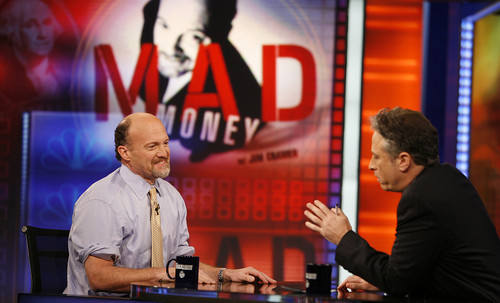
Two occurrences last Friday made me come back to this Huffington Post blog entry by Dan Solin. One, it was the 20th anniversary of CNBC's founding. The second was Jim Cramer's highly spirited retort to Mr. Solin's public mockery of "In Cramer We Trust" on CNBC. Cramer was so incensed that he interrupted Solin's interview to give him a piece of his mind. Where was that energy during his interview on The Daily Show, I wondered? Unfortunately, Cramer took the opportunity to attack John Bogle and defend his own prowess. It is with thoughts of financial news and their market-timing pundits, such as Cramer, that I write today.
Mr. Sorin's contribution to empowering Americans to take control of their financial future is nothing short of exemplary. While I haven't read "The Smartest Investment Book You'll Ever Read," I have heard great reviews. To him, I say, stay passionate.
However, in the great zeal seemingly everyone has taken in bashing pundits and financial news; I feel somebody needs to hear a rebuttal. While, undoubtedly in a perfect world, we would like to see the type of investigative journalism that would bring a greater credibility to outfits like CNBC and Bloomberg, if we had the option between the manner in which media coverage is conducted today or no coverage at all, which should we go with? If trashing the pundits that make bold predictions dissuades them from presenting their thoughts on the market, will it be worth it for us?
C. Warren Goldring -- Canadian Mutual Fund visionary passes away.
One of the Canadian mutual fund industry's forefathers, C. Warren Goldring, passed away today at 81 years of age.
Along with Allan Monford, he combined assets of small Canadian investors in order to gain access to the New York Stock Exchange. They named the fund American Growth Fund, which would later become the name for the entire fund family, the ninth largest mutual fund firm in Canada with an assets under administration of $34.5 billion. The year was 1957, and it was the first time the small Canadian investor had been given access to the US market. For all my issues with mutual funds, Goldring, himself, brought about an early foreshadowing of a more empowered Canadian investor. It is a sad day for Canada's retail investment industry.
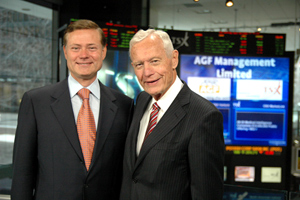
Below is a picture (courtesty of AGF.com) of C. Warren Goldring with AGF's current President and CEO, his son, Blake Goldring, at American Growth Fund's 50th anniversary in 2007.
Brilliant Frontline Documentary: "Inside the Meltdown"
The dramatic story that just took place detailing step-by-step the unravelling of the financial system. Of course, today's problems didn't just appear, but this documentary brings incredible insight into the players and their sentiment. The first of a three part series on the crisis.
With great difficulty, I will avoid elaborating and, instead, encourage you to watch the documentary yourselves. It begins as news of the possible fall of Bear Stearns ripples through the markets, and it continues with the fall of Lehman Bros and the disasterous results that follows, including the current experience at AIG.
An excellent description into the minds of those involved as they assessed moral hazard versus systemic risk.
The idea was to link to the Frontline page, but there seems to be a broken connection. So, we'll embed the documentary on this post. There is no doubt that the people at PBS will approve. Please visit www.frontline.com for great complementary resources to this material.
On the surface, it's incredible news, and it's been a catalyst for the markets' rise today. It sounds a little too rosy though. I'm skeptical. Such news coming up on the wake of the US government possibly ousting the banks' CEOs, and they aren't actually reporting record profits but saying they "will" report record profits. They're making it a point to let us know early?
Great report and great news though. If it's true that their merger with Wachovia is going smoother than expected, it really is fantastic to hear. However, transparency has been such an issue during this downturn, and it shouldn't be viewed as unfair to view this sudden revelation with a good degree of suspicion. Read the Article at HuffingtonPost
Last blog post, we reviewed some important moments of Jon Stewart's interview of Jim Cramer following their rather public feud. The post was dedicated to amplifying an important question Stewart asked Cramer. Now, it's important to discuss Cramer's response.
Cramer: Okay. First, my first reaction is absolutely we could do better. Absolutely. There's shenanigans and we should call them out. Everyone should. I should do a better job at it. But my second thing is, I talk about the shorts every single night. I got people in Congress who I've been working with trying to get the uptick rule [see first 1:40 of the clip below]. It's a technical thing but it would cut down a lot of the games that you are talking about.
The uptick rule was introduced by Securities and Exchange Commission in 1938 as a solution to the bear raids (see previous post) being used during that period. The intention of the uptick rule was to make it difficult for excessive short selling. An uptick occurs when a stock trades upward. The uptick rule stated that short sales could only be made on stocks with an uptick or if the stock price remained the same provided that it is higher than the last posted price.
This has been helpful because when one trader or hedge fund takes a large short position, nothing will stop the whole group from leaping on board and driving that stock down. With short selling, the investor is selling first and then buying back at a later date. If everybody is short selling, there is a high volume of selling going on, pushing the stock down. The company, which very well might have solid fundamentals, is being reduced to rubble as traders and/or hedge fund managers place their short sales like flies hovering around a steak that has been left outside during a hot summer day. Yes Yes Yes, folks. An awful simile, isn't it? The point is, if the short sellers cannot move when the stock price is going down, the stock's cascading descent is slowed considerably.
It was revoked in 2007. While there is a great deal of conjecture as to why, the official reason was to analyze how the markets did without the uptick rule. The rule had existed for decades, and the underlying rationale was that it quite possible made no difference. Behind the scenes, however, there was a great deal of talk that lobbying from private interest groups were at play. Those against it felt that there was no proof that it prevented a stock from plummeting. Others went further, claiming that it deterred all forms of short selling even during an uptick and prevented proper price discovery, which is considered an abhorrent thought by many.
Although the relevance of the uptick rule on the markets, particularly a bear market is subject to debate. Regardless, the public outcry to reimplement the uptick rule has grown so strong that Congress has no choice but to act. Whether the solution is reimplementing the uptick rule as it was before or in some other form, it has yet to be decided.
I'd like to end this series of posts, which were inspired by the Cramer Vs. Stewart interview, with a clip from Jim Cramer . Like I said, I've never been a fan of his on-screen persona, but this clip contradicts what Jon Stewart was accusing him of, which was basically ignoring the plight of the retail investor. Watch the first 1:40 of the clip. He describes the bear raid and then promotes the use of the uptick rule, an argument he could have presented more passionately on The Daily Show.
No matter how bad his recommendations have been (and trust me, they have been bad), his intentions shouldn't be construed as malicious.
In my last post, I expressed a great deal of frustration with the lost opportunity Cramer and Stewart passed up to educate an engaged audience. Probably one of the more notable examples of this came when Jon Stewart presented Jim Cramer with video clips of himself from 2006. The Daily Show pointed out segments like:
Cramer: You know a lot of times when I was short at my hedge fund and I was positioned short, meaning I needed it down, I would create a level of activity beforehand that could drive the futures. It doesn't take much money.
Cramer: I would encourage anyone who is in the hedge fund unit 'do it' because it is legal. It is a very quick way to make the money and very satisfying. By the way, no one else in the world would ever admit that...
What was he talking about? You can tell Stewart's entire 'beef' of the interview lay in getting Cramer to justify such comments. Of coures, Cramer didn't. Neither really explained what he was talking about. It was just assumed it was understood.
I thought it would useful to do a quick breakdown of this dialogue. Stewart was trying to motivate Cramer to discuss a "bear raid." A strategy, although more common during the early 20th century, that involves taking large short positions (and/or colluding with others to take large short positions) and spreading unflattering rumours of the target firm with the set goal of dragging the share price down. The group profits between the original share price and the price that the share price has been dragged down to. This brings a "surer thing" to big-wig traders and hedge funds, while leaving the retail investor, saturated in the buy-and-hold philosophy, out to dry.
A recent example that comes to mind of rumours being spread in the market to get a share price down was when rumours were flying that a healthy Steve Jobs was terminally ill. Every time those rumours gained traction, it sent Apple shares down. There is a great deal of speculation attributing these unsubstantiated rumours to hedge funds. While, today, the poor Jobs has actually taken time off to deal with some sort of illness, traders and hedge funds managers, I believe, have been poking at his health for years.
An unusual thing was that Cramer in the 2006 video commented this behaviour was perfectly legal, which is not entirely true as it might represent securities fraud.
Next blog post we'll review Cramer's response, mentioning a little thing called the "uptick rule." Huh? Uptick rule?
Do you remember watching an entire show at a particular time to wait for a particular segment? It really almost feels like something our great grandpappies did. Comedy aside...today, we can simply be alerted to snippets of information by our peers or by certain publications and the relevant piece can easily be found online. Such was the case this weekend when a brilliant pathologist friend of mine took me through clip by clip of the battle between The Daily Show's Jon Stewart and Mad Money's Jim Cramer. Now, this had been the news of the week all last week. Had this been a past era (and by "past era," I mean a few years ago), the favoured water cooler conversation of the moment would totally have been missed by myself.
It all began with the Daily Show putting together a very effective onslaught of CNBC's coverage of the financial markets. The piece was a substitue to a cancelled guest appearance by CNBC's Rick Santelli, who was due to explain his opposition and subsequent reporting of homeowners being saved from foreclosure with government bailout funds. Part of the collage of attacks were clips of Mad Money's Jim Cramer giving bad calls on Bear Stearns and Bank of America. Cramer, taking exception to the comments, went on a media blitz undermining Stewart, and we had ourselves one of the more compelling media personality rivalries this year.
Stewart's attack was legitimate and eloquent. It made a point stressed by investor advocates for years: the ineffective coverage of news organizations. Numerous clips were played illustrating the CNBC's staff lack of effective reporting and greater priority being placed on being the mouthpiece for the companies they were reporting on than any sort of investigative journalism. However, Stewart's observations was hardly old news. For example, it was Vanity Fair that first commented on the suspicious Enron, not the Wall Street Journal or Financial Times.
It was Cramer's appearance on the Daily Show after much bickering back and forth that I want to draw attention to. The two men were given a huge audience to discuss incredibly important issues, and Cramer simply chose to be Jon Stewart's punching bag, acknowledging everything coming out of Stewart's mouth while not taking an opportunity to amplify the issues. My personal resentment of the show, Mad Money, has existed since the show came out. But, in all fairness, Cramer failed to point out his definition of Mad Money, which was "...not retirement money, which you want in 401K or an IRA, a savings account, bonds or the most conservative of dividend-paying stocks." Furthermore, the challenge of having an avenue in which everyday you are putting a buy or sell recommendation on a stock to be evaluated by a broader public is a tough gig. Nobody else does it (not on such a grand scale anyway). Cramer's past hits and misses is noted at the end of each show, and his lack of success can easily be evaluated. Mutual fund managers do have to provide disclosure on their top holdings but not in real time, and hedge fund managers do not have to talk about it at all.
For all my criticisms of "Mad Money," Cramer should have pointed out that the show does succeed in giving people a way to educate themselves about the markets in an entertaining manner. For every verdict Cramer renders on a company, he does talk about his reasons and about the company themselves. It has made people more engaged, increasing their IQ of publicly-traded companies. Of course his theatrics and yelling, while aggravating myself, also did entertain his audience bringing an audience bored with the normal presentation of business reporting into the mix.
This all being said, my love for the Daily Show and Jon Stewart is quite strong, as watching these clips did provide a sense of satisfaction. Vital issues for investor (and this means all of us) rights were being presented to a mainstream audience. There seems to be a definite interest for business news to not spark widespread selling, and this does mislead the public. Stewart was right to define the participants in the markets into two groups: the retail investors saving for retirement and the cowboys (and girls) on the institutional side. Keep up the good work guys.
My next blog post is going to be about the behaviour of hedge funds in this whole mess. During the interview, Cramer, a former hedge fund manager, was questioned about the comments he made in an interview several years ago. Neither of the two gentlemen fully explained the issue. Stay tuned.
A terrific explanation considering how simple he kept it. It is presented in an entertaining and easy-to-understand way, although this does come at the expense of overgeneralizing some parts.
The following is the thesis project of Jonathan Jarvis toward the completion of his MFA.
Being Canadian, you have definitely been part of, if not been a witness to, the Canada vs. United States debate. Which is the better country, we have felt the need to ask? As a means of strengthening our identity, we have resorted to the practice of comparing ourselves to the United States. Such a practice, it can be argued, has been found to stress our inferiority complex not rid ourselves from it.
Although the need for us to make such a comparison can be argued, it can be saved for another day as this week's Newsweek column from the great Fareed Zakaria must be recognized. Fareed Zakaria, editor of Newsweek International and the former managing editor of Foreign Affairs, writes a terrific Newsweek column comparing the two countries, focussing on why Canada is proving themselves to be greater particularly during such uncertain economic times. Enjoy! As a proud Canadian, there is no doubt that you will...
Last blog post, we introduced you to the wholesaler. It is a job in the financial services industry you never hear about but may play a significant role in the mutual fund you invest in. To review, in order to get financial advisors to carry their investment products, mutual fund firms employ “wholesalers,” whose job it is to persuade advisors to understand why their funds are better than the rest of the industry.
In this entry, we're going to further explore some dynamics in the wholesaler-financial advisor relationship.
Now, it would be a great to think that an advisor uses their analytical prowess to decipher the mutual fund that is going to beat the index year after year. However, such prowess, particularly for the larger funds and more prevalent asset classes (for example, a Canadian equity fund), is not significantly different from one mutual fund company to another. With this in mind, the advisor's assessment of giving a mutual fund firm his or her client's business shifts to more subjective traits. One of those traits is their relationship with their wholesaler [another can be the trailer fee, which we'll discuss another time].
In essence, the wholesaler-financial advisor relationship is much like the relationship between a financial advisor and their client. Like financial advisors, wholesalers earn a commission (8 to 12 basis points, we've been told, of the assets they are responsible for bringing under management), while earning a salary as well. Like financial advisors, wholesalers are responsible for recruiting their clients (in their case, the financial advisors) and nurturing them.
It is important to note that wholesalers are given what are called expense accounts (according to several sources, a typical expense account can range anywhere from $20,000 to $50,000 for a geographic area depending on the firm) to, among other things, entice advisors to carry their products. These incentives could be, for example, tickets to shows, sporting events or dining out. In the past, such incentives were out of control with all-expense paid trips and more lavish attempts to win a broker's loyalty. Fortunately, much of this has toned down in the last few years. That being said, a financial advisor's loyalty can still be won in such ways. In fact, in many cases, it is the advisor who has come to expect special treatment in return for them investing millions of their clients' money with a specific firm.
Now, yes, all is fair in love and war, but when you think about it, there can be about 20 wholesalers for the typical mutual fund company (maybe four wholesalers assigned to Ontario, for example). And these five figure expense accounts per wholesaler would be more beneficial to the Canadian client lowering the fund's MER. Of course persuading advisors to carry their products is important, but eliminate or reduce the expense accounts, I say. Let a financial advisor pick a mutual fund on the merits of the fund alone. Let the wholesaler's job be solely to preach the merits of their fund.
The feeling is, though, this is not the start of a groundbreaking movement.